
Introduction
Word games have become one of the most popular forms of entertainment and learning in the digital age. Millions of people challenge themselves every day with crossword puzzles, anagrams, vocabulary quizzes, and five-letter word games that improve both language skills and critical thinking. One search term that has gained significant popularity among puzzle enthusiasts is wordhippo 5 letter words, as many players look for reliable ways to discover suitable words while expanding their vocabulary.
Whether you are solving daily word puzzles, preparing for spelling competitions, improving your English vocabulary, or simply enjoying language-based games, understanding how five-letter word searches work can significantly improve your performance. Vocabulary tools help users discover words based on length, letter positions, meanings, synonyms, and other language characteristics. This comprehensive guide explains everything about wordhippo 5 letter words, including their importance, practical uses, educational benefits, puzzle-solving techniques, vocabulary development, and strategies that help players become more confident in word games.
What Are WordHippo 5 Letter Words?
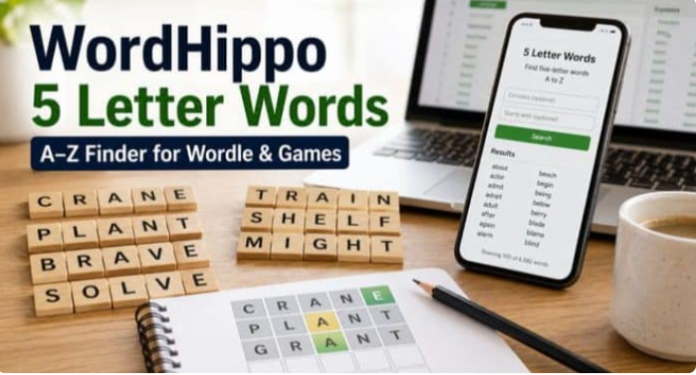
The phrase wordhippo 5 letter words generally refers to searching for five-letter English words using vocabulary reference tools designed for language learning and puzzle solving. These resources organize thousands of words according to their length, spelling, beginning letters, ending letters, and included characters.
Instead of manually thinking through every possible word combination, users can quickly locate matching words that fit puzzle requirements. This makes solving crossword puzzles, word challenges, spelling exercises, and educational activities much easier.
Five-letter words are especially common because many modern word games use exactly five letters as the primary challenge, making these searches useful for players of all experience levels.
Why Five-Letter Words Are Popular
Five-letter words have become increasingly popular because they offer an ideal balance between simplicity and difficulty. They are long enough to create meaningful vocabulary challenges while remaining manageable for beginners and experienced players alike.
Many educational games use five-letter vocabulary because students can learn spelling patterns without becoming overwhelmed by lengthy words. Puzzle creators also prefer this word length because it allows numerous combinations while maintaining logical difficulty.
The growing interest in wordhippo 5 letter words reflects how people combine learning with entertainment through interactive language activities.
Regular practice with five-letter words helps strengthen both vocabulary and logical reasoning skills.
Importance of Vocabulary in Word Games
Vocabulary forms the foundation of successful word puzzle solving. Players with broader vocabularies recognize more words, identify spelling patterns quickly, and solve puzzles with greater confidence.
Learning new vocabulary also improves reading comprehension, writing ability, communication skills, and academic performance. Every unfamiliar word discovered during a puzzle becomes an opportunity to expand language knowledge.
Vocabulary resources simplify this process by organizing words according to useful categories that support both learning and gameplay.
Developing vocabulary gradually leads to long-term improvement across many language-related activities.
How Vocabulary Search Tools Work
Modern vocabulary search systems organize words using multiple searchable characteristics. Users can search for words beginning with specific letters, ending with certain letter combinations, containing particular vowels, or matching exact letter patterns.
Some searches allow unknown letters to be replaced with placeholders, helping players narrow possible answers without knowing the complete word.
This systematic organization makes finding appropriate vocabulary much faster than manually reviewing dictionaries or word lists.
Understanding search methods allows players to solve increasingly difficult puzzles more efficiently.
Benefits of Using Word Search Resources
Vocabulary resources provide numerous advantages beyond puzzle solving. Students use them for educational assignments, writers discover suitable words for creative projects, and language learners improve their English skills.
These resources also include definitions, synonyms, antonyms, rhyming words, translations, and pronunciation guidance, making them valuable language-learning tools.
Regular use encourages curiosity about language while improving spelling accuracy and vocabulary retention.
Many professionals also rely on vocabulary tools during writing and editing tasks.
Common Games That Use Five-Letter Words

Many popular word games focus specifically on five-letter vocabulary because it provides an engaging level of challenge. Crossword puzzles frequently include five-letter answers that intersect with multiple clues.
Daily guessing games encourage players to identify hidden five-letter words using limited attempts. Educational spelling competitions and vocabulary quizzes also commonly feature words of this length.
Teachers often create classroom activities using five-letter vocabulary because students can understand and memorize these words more easily.
The versatility of five-letter words contributes to their widespread popularity.
Strategies for Solving Five-Letter Word Puzzles
Successful puzzle solving begins with careful observation of known letters and their positions. Identifying common prefixes such as “un” or “re” and suffixes like “ing” or “less” can reduce possible answers.
Recognizing common vowel placements also improves accuracy because most English words follow familiar spelling patterns.
Players should avoid random guessing and instead eliminate unlikely possibilities systematically.
Regular practice strengthens pattern recognition, allowing experienced players to solve puzzles more quickly and accurately.
Patience and logical thinking remain important throughout the solving process.
Educational Advantages of Word Games
Word games provide significant educational benefits for learners of all ages. Students improve spelling, grammar, pronunciation, vocabulary, and reading comprehension through interactive practice.
Teachers often integrate language puzzles into classroom lessons because they encourage active participation and improve student engagement.
Adults also benefit from vocabulary exercises that maintain language proficiency while supporting lifelong learning.
Interactive learning activities generally produce better long-term retention than passive memorization alone.
These educational benefits explain why word puzzles remain widely used in schools and self-learning programs.
Improving English Vocabulary
Expanding vocabulary requires consistent practice and exposure to new words. Reading books, newspapers, magazines, and educational articles introduces learners to unfamiliar vocabulary within meaningful contexts.
Keeping a personal vocabulary notebook allows students to record new words together with definitions and example sentences.
Solving puzzles regularly reinforces previously learned vocabulary while introducing additional words naturally.
Language improvement becomes more enjoyable when combined with entertaining activities rather than repetitive memorization.
Consistent effort produces noticeable improvement over time.
Common Mistakes Players Should Avoid
Many beginners rely on random guessing instead of analyzing available clues carefully. This approach often wastes opportunities and makes puzzles more difficult.
Ignoring common spelling rules or overlooking simple vocabulary can also reduce solving accuracy. Some players focus only on unusual words while forgetting that everyday vocabulary often provides the correct answer.
Another common mistake involves giving up too quickly when facing difficult puzzles.
Developing a systematic solving method helps players avoid these errors while improving confidence and efficiency.
Technology and Digital Vocabulary Learning
Technology has transformed vocabulary learning through interactive educational applications, intelligent search systems, and personalized learning platforms.
Artificial intelligence now helps learners receive customized vocabulary recommendations based on their skill levels and previous performance. Mobile applications provide convenient access to vocabulary practice anytime and anywhere.
Gamification techniques encourage continuous learning through rewards, achievements, and daily challenges.
Digital innovation continues making language education more engaging and accessible for learners worldwide.
Tips for Building a Strong Vocabulary
Building a strong vocabulary requires regular reading, writing, listening, and speaking practice. Learning several new words each week gradually creates lasting improvement.
Using newly learned words in conversations and writing assignments strengthens memory and practical understanding.
Reviewing vocabulary regularly prevents forgetting while reinforcing language skills over time.
Participating in word games, quizzes, and spelling challenges adds variety to the learning process and keeps motivation high.
Small daily improvements eventually lead to substantial vocabulary growth.
Future of Word Games and Vocabulary Tools
The future of vocabulary learning will likely become even more interactive through artificial intelligence, voice recognition, adaptive learning systems, and immersive educational experiences.
Personalized learning platforms may recommend vocabulary based on individual interests, skill levels, and learning progress.
Advanced digital tools will continue helping students, teachers, writers, and puzzle enthusiasts improve language skills efficiently.
As educational technology evolves, vocabulary learning will become increasingly personalized, enjoyable, and effective.
Frequently Asked Questions
What does wordhippo 5 letter words mean?
Wordhippo 5 letter words generally refers to searching for five-letter English words using vocabulary tools for puzzles, games, writing, and language learning.
Why are five-letter words important?
They are widely used in crossword puzzles, vocabulary games, educational exercises, and spelling competitions because they offer a balanced level of difficulty.
Can vocabulary tools improve English?
Yes. They help users expand vocabulary, improve spelling, understand meanings, and strengthen communication skills.
Are word games useful for students?
Absolutely. Word games improve memory, vocabulary, spelling, reading comprehension, critical thinking, and overall language development.
Conclusion
The growing popularity of wordhippo 5 letter words demonstrates how vocabulary resources have become valuable tools for both education and entertainment. Whether solving crossword puzzles, participating in daily word challenges, improving English vocabulary, or preparing for academic activities, five-letter word searches provide an efficient way to strengthen language skills.
Regular vocabulary practice enhances communication, reading comprehension, spelling accuracy, and critical thinking while making learning enjoyable. By combining consistent study with logical puzzle-solving strategies, learners of all ages can steadily improve their language abilities. As digital learning technologies continue advancing, wordhippo 5 letter words will remain an essential concept for students, writers, teachers, and puzzle enthusiasts seeking to expand their vocabulary and enjoy the rewarding challenge of word games.

